This generation of AIs will be the last to be raised by humans. The next generations of AIs will be raised by AIs. We have one shot to get this right.
Publisher: MIT Press
Pages: 280
Section: Nonfiction
Price (hardcover): $24.95
Publication date: June 2026
ISBN (paperback): 9780262054324
Price (hardcover): $32.95
Publication date: June 3, 2025
ISBN (hardcover): 9780262049764



Subscribe free for pre-release previews of Raising AI and keep updated with De Kai.
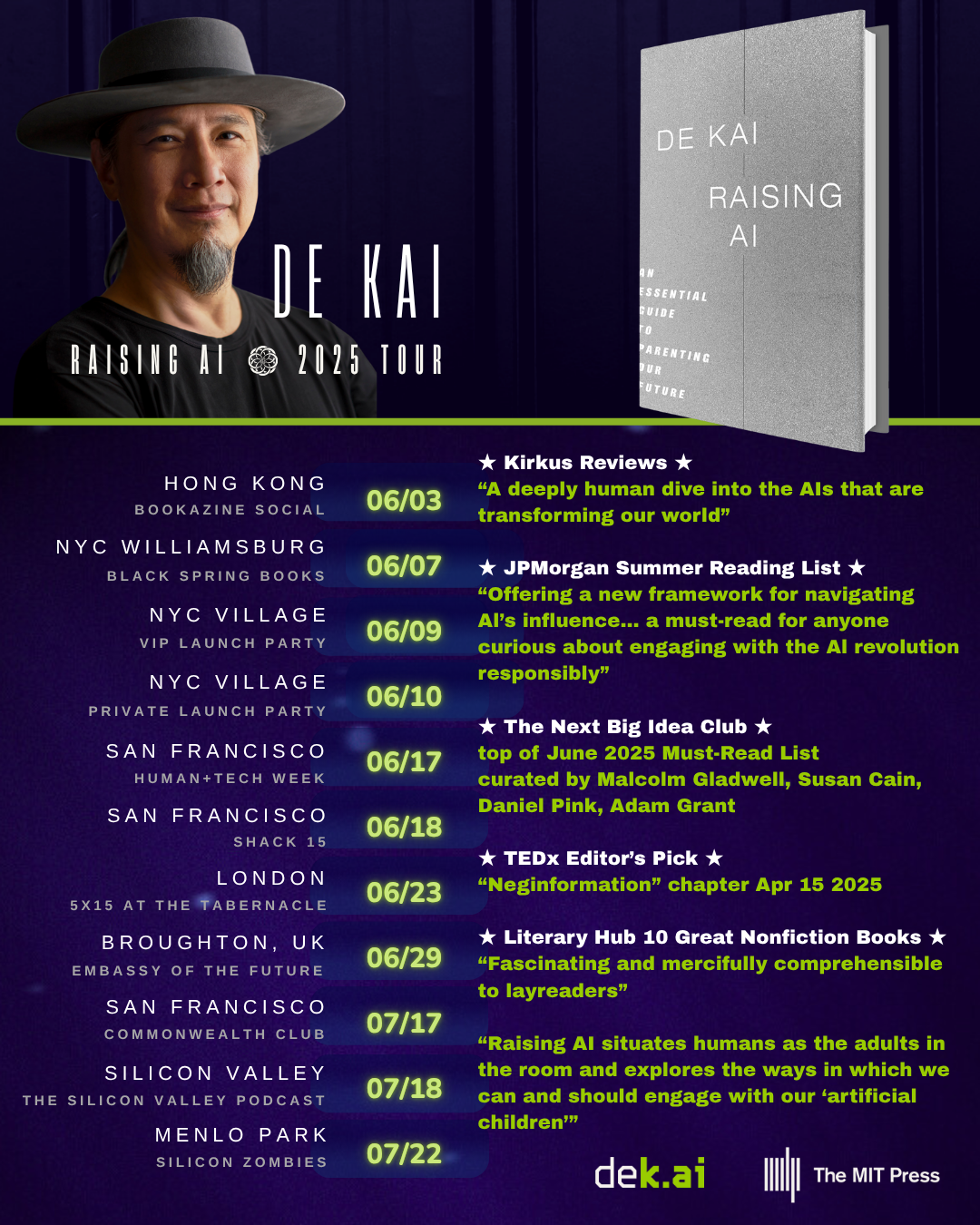
JP MORGAN, Summer Reading List 2025 “Offering a new framework for navigating Al’s influence, this book is a must-read for anyone curious about engaging with the Al revolution responsibly.”
JANE METCALFE, Wired magazine cofounder “There’re those who understand AI and who are actually building AIs, and then there’s the rest of us. It’s a new divide. This book is for the rest of us.”
GEOFFREY HINTON, Nobel laureate, Turing Award winner, godfather of deep learning “It was stimulating for me to consider what De Kai has to say about the future of AI, particularly his idea that we have already lost our autonomy.”

Subscribe free for pre-release previews of Raising AI and keep updated with De Kai.
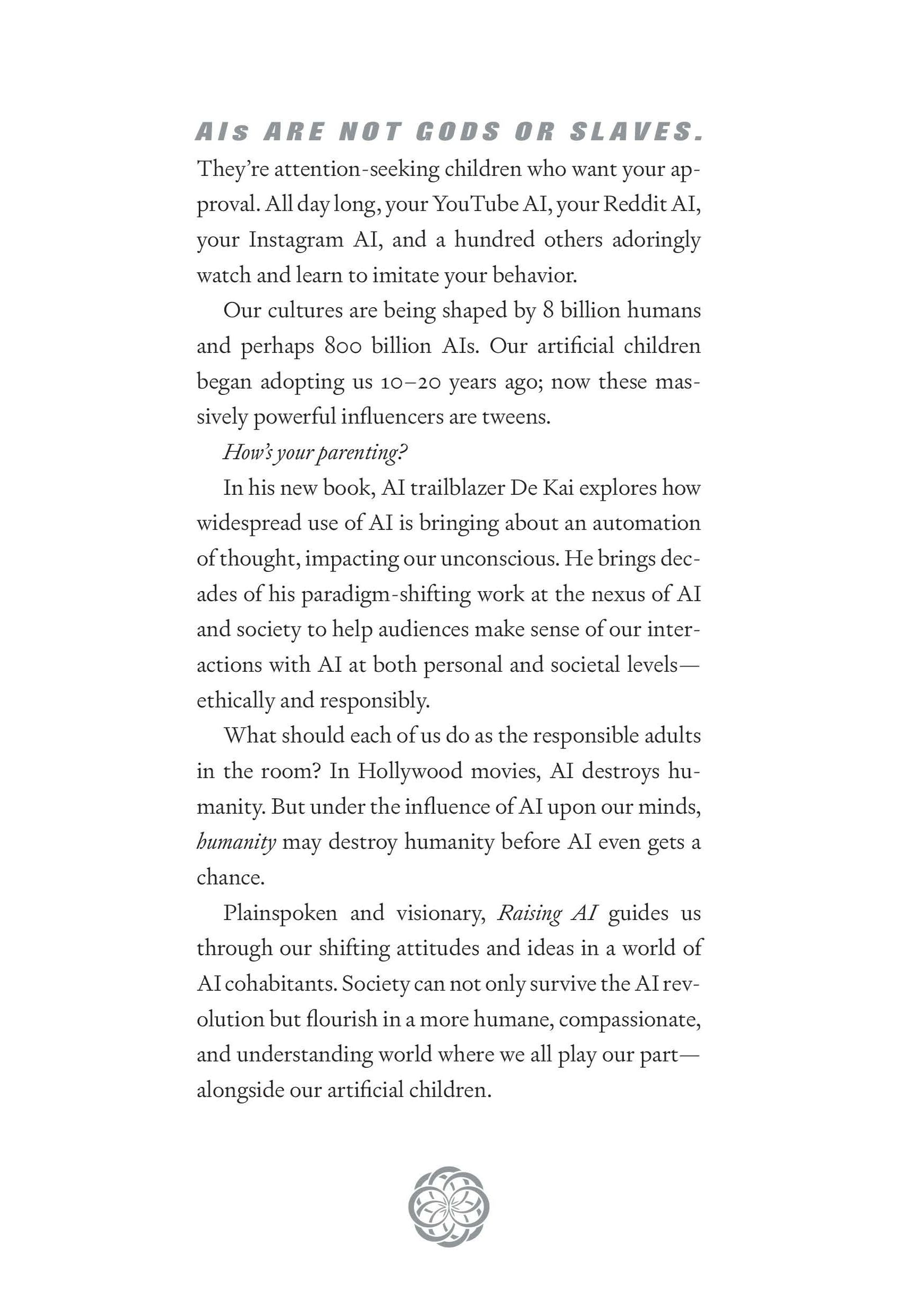
Our artificial children began adopting us 10–20 years ago; now these massively powerful influencers are tweens.

Raising AI is one of 16 titles whose “groundbreaking ideas” are included in JPMorgan’s 26th annual famed Summer Reading List of books that JPMorgan is gifting to thousands of clients worldwide.
CNBC writes that “top summer reading list for the wealthy this year includes books on happiness, resilience, artificial intelligence and the future of the U.S. dollar” and “has become the go-to selection of beach books for the wealthy”. The list “was compiled from more than 1,000 suggestions from JPMorgan’s client advisors and whittled down by a special review committee”.
Quartz reports that JPMorgan’s Summer Reading List “functions somewhat of a cultural mood board for the global elite. What started as solely a collection of nonfiction has evolved into a full-blown curiosity cabinet, curated from hundreds of recommendations submitted by JPMorgan’s wealth advisors and clients around the world”.
Fortune explains that “The Wall Street giant has been running the list since 1999, compiling more than 1,000 recommendations from its client advisors annually, before a special committee whittles it down to the crème de la crème of literature… And while anyone can enjoy JPMorgan’s list of good reads, this year Gen Alpha and Gen Z were taken into account, after wealthy patrons from its private investment arm said they craved guidance for their children who will eventually step into their shoes. ‘From our family office survey, what we heard loud and clear was that values are very important to the next generation.’”
Of Raising AI, Quartz says “In this book, AI translation pioneer De Kai explores how to understand and ethically engage with AI to empower the future — a future where humanity and AI coexist in harmony”.
JPMorgan explains its decision to put Raising AI on its must-read list:
How is the widespread use of Al impacting our world and culture? As the pioneer of translation Als such as Google, Yahoo and Bing translate, De Kai provides an insightful guide to understanding how Al can empower the future as Al reshapes civilization.
Raising Al prompts readers to consider its ethical implications and our active role in this shift, advocating for a future where humanity and Al coexist harmoniously.
Offering a new framework for navigating Al’s influence, this book is a must-read for anyone curious about engaging with the Al revolution responsibly.
Raising AI tops The Next Big Idea Club’s June 2025 Must-Read Books, curated by Susan Cain, Malcolm Gladwell, Adam Grant, and Daniel Pink.
De Kai’s “Neginformation” talk, drawn from chapter 12 of Raising AI, was named as the April 15 TEDx Editor’s Pick — an honor bestowed to a tiny fraction of over 55,000 TEDx talks per year.
Guiding us through the origins and ethics of AI.
What is artificial, what is intelligence, and how are the AI systems surrounding us being created? In this clear and engaging volume, De Kai, a pioneer in machine learning and natural language processing, invites readers into the history of AI to explore deeply philosophical questions on the nature of human thinking and belief.
With humor, diagrams, and plentiful examples, De Kai takes readers below the surface of popular chatbots and search engines to the broad field of scientific inquiry living at the intersection of psychology, philosophy, and computer science, reflecting researchers’ observations about human intelligence.
Artificial brains that mirror and learn from human behavior and culture learn our biases and stereotypes. Creating ethical, empathetic models requires our careful nurturing, as we might nurture children. AI’s infamous darker side skews the news, generates deepfake images, amplifies biases, and dangerously polarizes political discourse.
De Kai notes that companies would prefer industry-wide guidelines and a level playing field to craft responsible (but unprofitable) AI controls. The impact on jobs and creative endeavors is not the focus here; this volume does not dwell on the underlying economics of various models and companies.
But instilling empathy and ethics in our artificial influencers calls for guiding them so they can guide us. Suggestions on how to perfect our AI “children” are detailed and thoughtful, while evoking Jorge Luis Borges’ tale of a mapmaking process so exacting it grows as large as the world it represents.
Ultimately, this primer argues that the stakes are high, the situation is urgent, and we all have a role to play. By engaging with AI consciously and ethically, we can help shape better systems—by first calling forth our better selves.
A deeply human dive into the AIs that are transforming our world.
Kirkus Reviews, May 1, 2025 (published online April 4, 2025)
If you’re anything like the staff of Lit Hub, you’re likely grappling daily with the existential uncertainty of the future of AI. De Kai, a “pioneer of translation AIs,” is a worthy guide to the dangers and possibilities of the technology. Fascinating and mercifully comprehensible to layreaders, Raising AI situates humans as the adults in the room and explores the ways in which we can and should engage with our “artificial children.” Why not give your dread a little break?
Literary Hub, 10 Great Nonfiction Books to Read in June (published June 2, 2025)
De Kai’s urgent book Raising AI reflects the ethical impacts of the Artificial Intelligence industry and moral quandaries raised by its influence on public and private life.
Drawing an analogy between artificial intelligences computer scientists code into existence and children, this book does the vital work of encouraging citizens and corporations alike to “parent” AI, raising it in much the same manner one would raise a child. The book delves into the unique challenges of machine learning, which causes algorithms to inherit humanity’s historical biases, spread misinformation, and ensnare users in echo chambers that amplify longheld beliefs through curated feeds. A strong argument is made for treating artificial intelligence as a childlike entity worthy of moral, ethical, and emotional investment.
This book delivers its compelling argument in a clear, concise, and candid manner. At times, it adopts a colloquial tone, yet it remains grounded in the tenets of computer science and technological ethics throughout. Positing that all internet-connected members of a society serve as the “parents” of algorithms and smart devices delivers hope among myriad examples of large technology conglomerates absconding their ethical and parental duties.
The arguments are grounded in the philosophical tenets of computer ethics and are enhanced by anecdotes from experiences at the cutting edge of technology. A quote from Peter Norvig, the founding director of Google Research, raises the question of whether or not AI can think critically. This and other ideas presented in this book may, at first glance, seem futuristic, but they are indicative of a deep understanding of AI and demonstrate decades of experience in the industry, lending credence to the predictions and prescriptive measures presented.
Raising AI is a compelling treatise grounded in studies of ethics and technology that charts a path toward greater understanding between biological and artificial intelligences.

DE KAI is a pioneer of AI. Three decades ago his PhD thesis argued for using statistical machine learning in natural language processing. Today’s artificial intelligence would not exist without statistical approaches like probability theory and neural networks, but in the 1980s they were considered radical.
De Kai built the first global translator and invented groundbreaking language models, spawning Google Translate and Microsoft Translator. For his contributions, he was honored by the Association for Computational Linguistics as one of its Founding Fellows.
Born in St. Louis, De Kai holds joint appointments at HKUST’s Department of Computer Science and Engineering and Berkeley’s International Computer Science Institute. He is Independent Director of the AI ethics think tank The Future Society and was one of eight inaugural members of Google’s AI ethics council.
Publisher: MIT Press
Pages: 280
Price (hardcover): $32.95
Publication date: June 3, 2025
ISBN (hardcover): 9780262049764
Section: Nonfiction
